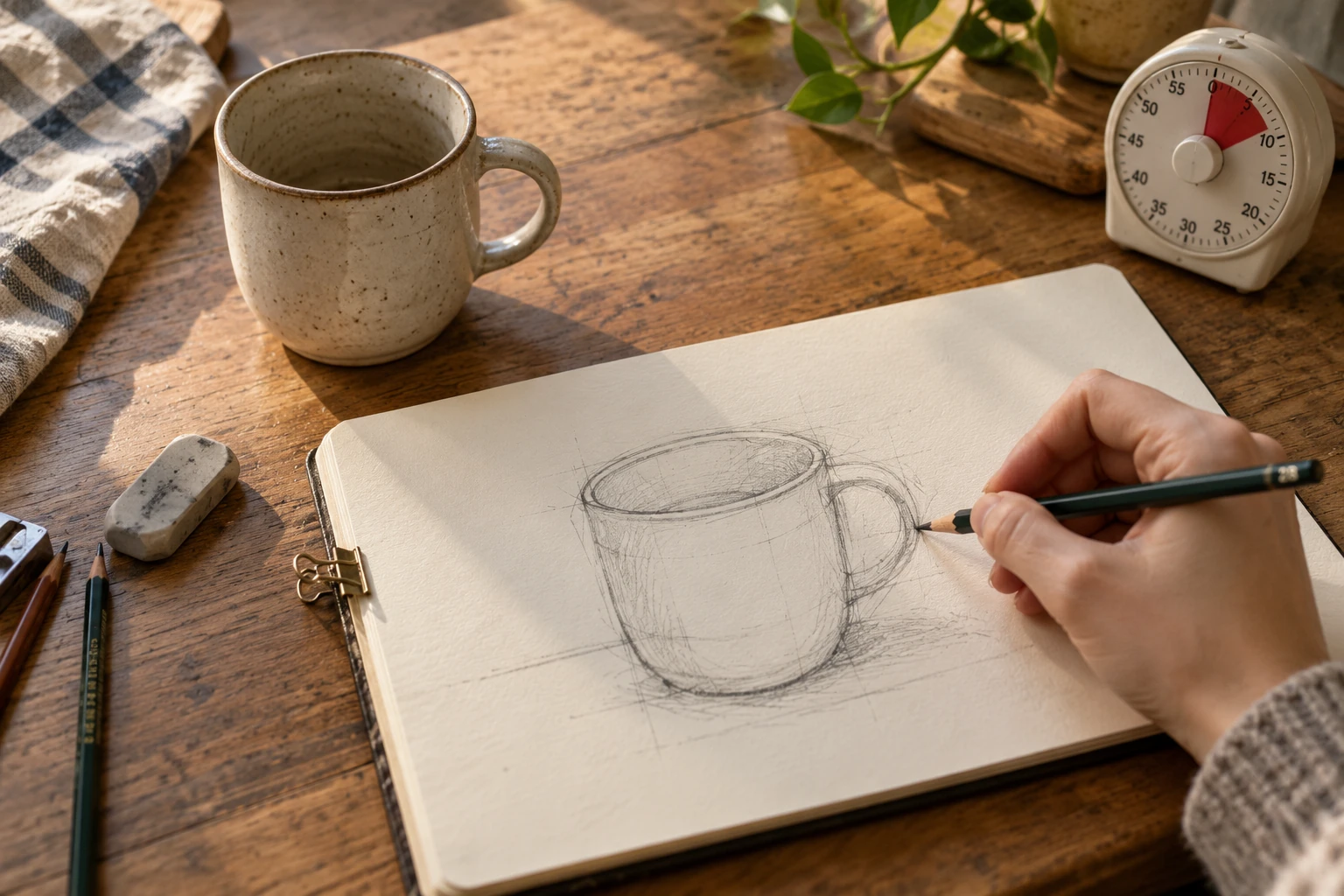
A five-minute observation drill can help you draw more accurately before you put a single line on the page. But most beginners do the opposite. They start sketching immediately, then try to fix proportion and placement as the drawing takes shape. By then, one wrong guess might throw off everything around it.
The fix doesn’t require more drawing time. It starts with looking before you draw. We’ll break down the five-minute observation routine, explain why it works, and give you five short exercises to practise it every day.
Why Observational Drawing Comes First: The Science of Seeing Before Sketching
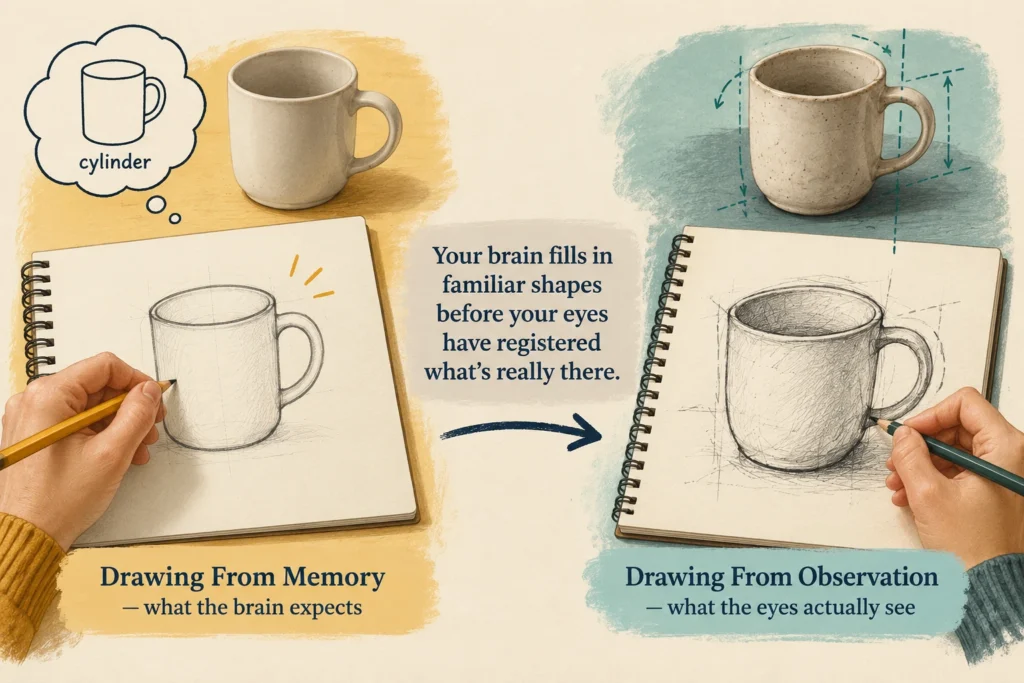
To draw what you actually see, you first need to train yourself to look closely. Without that habit, your brain can fill in familiar shapes and details before your eyes have properly registered what’s in front of you. The result is a sketch based partly on observation and partly on what you expect the subject to look like.
The bigger issue is that most of us start drawing long before we think about how we’re looking. Visual arts instruction is still common in US public schools. In the 2024–25 school year, 82% offered visual arts classes, according to the National Center for Education Statistics (NCES).
But spending time with a pencil doesn’t automatically teach you how to observe. You need to pay attention to what your eyes are actually telling you.
Three things happen when you give observation the first few minutes of your drawing session.
1. Your Brain Stops Filling in the Blanks
When you look at a familiar object, your brain already has an idea of what it should look like. You might see a cup and immediately think “cylinder,” or see an eye and draw the familiar almond shape you have used dozens of times before.
That shortcut is useful in everyday life, but it can work against you when you’re drawing from observation. Instead of recording the exact shape in front of you, you end up drawing the version your memory expects.
Taking a few moments to study the subject interrupts that shortcut. Look at the edge of the cup. Notice where it curves, where it narrows, and how its width changes from top to bottom. Now your pencil has specific information to follow rather than a familiar symbol to reproduce.
2. Your Hand Gets Better Information to Follow
Drawing is not only a hand skill. Your eyes first notice a shape or relationship, your brain interprets it, and your hand turns that decision into a mark.
If you start drawing before you’ve looked carefully, your hand has less information to work with. You may place an edge too high, make a shape too wide, or miss a subtle change in direction. More practice won’t necessarily correct those mistakes if you keep repeating the same rushed-looking habit.
A short observation period gives your eyes time to make those decisions first. Your pencil then has a clearer job: record what you’ve already noticed.
3. You Start Seeing Relationships
Careful observation also changes what you look for. Instead of seeing a collection of familiar objects, you start comparing the shapes and spaces between them.
How wide is one shape compared with another? How much space sits between two edges? You begin noticing where angles change direction and how one part sits in relation to another.
These relationships are what help a drawing look accurate. You don’t need to measure every millimetre, but you do need to notice those relationships before you draw them.
That is why observation comes first. The goal isn’t to spend less time drawing. It’s to make the time you do spend drawing more informed.
How Long Should Your Warm-Up Drawing Sketch Really Take?
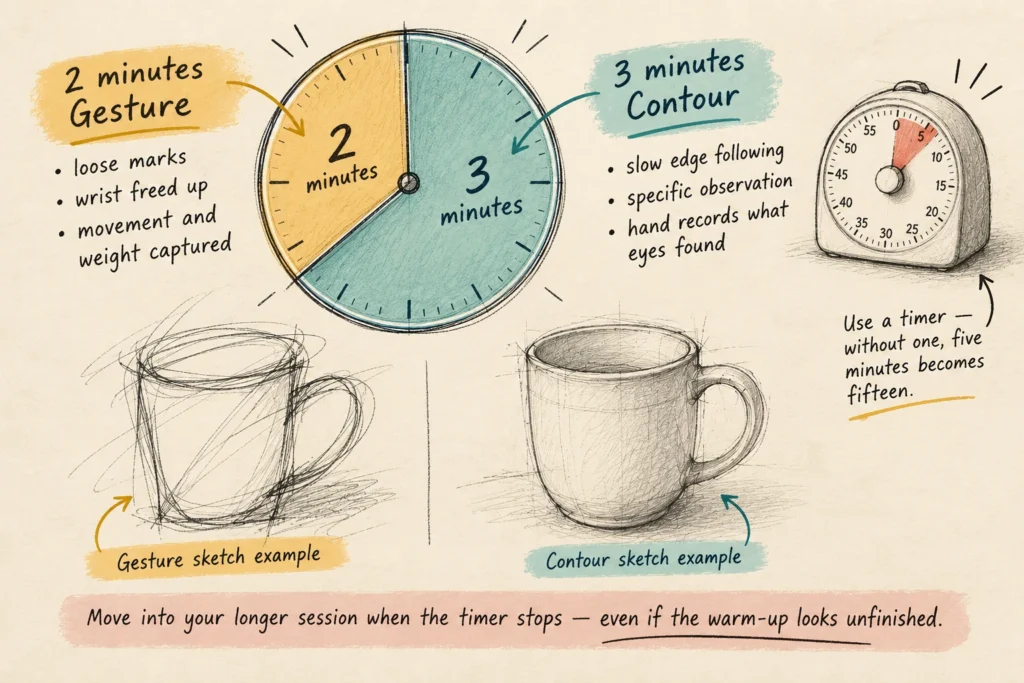
The warm-up takes five minutes total. Split the time between quick gesture marks and slower contour work. Two minutes of loose gesture frees your wrist. The other three belong to edges you follow slowly.
Each half has a different job. Gesture helps you capture movement and weight, while contour work trains you to follow the actual path of an edge. This way, you warm up your hand without letting the quick marks take over the whole exercise.
If you’re not sure you’ll stick to five minutes, use a timer. From our experience, it makes the limit much easier to follow. A kitchen timer works fine, too. Without one, five minutes can easily stretch into fifteen and swallow the longer drawing session you planned.
Keep the subject simple while you learn. A mug, a pinecone, or your own hand breaks into basic shapes you can check quickly. Faces reward the same techniques, but they punish rushed looking, so save them until the habit holds.
Once the timer stops, move into your longer work, even if the warm-up still looks unfinished on the page.
Five Beginner Sketching Exercises That Sharpen Your Eye
Now it’s time to put the five-minute routine into practice. These five observation exercises train you to notice shape, proportion, edges, and negative space before your hand starts guessing.
Each drill takes less than two minutes, so you can fit several into one session. Work through all five, then spend more time on the exercise that feels hardest.
- Contour Drawing: We mentioned keeping the subject simple earlier, so start with that mug, pinecone, or hand. Slowly follow its edge with your eyes while your hand traces the same path on paper. And don’t forget to keep your eyes on the subject rather than the page, so you train yourself to connect what you see with the marks you make.
- Negative Space Study: The object itself isn’t your focus here. Look at the empty shapes around and between it, then sketch those spaces instead. Comparing them can reveal proportion and placement errors that are easy to miss when you focus only on the object.
- Draw From Memory: Give yourself 30 seconds to study a simple subject, then turn away and draw what you remember. Compare the result with the subject afterward. The differences show you which details your eyes recorded and which ones your brain filled in from memory.
- Shape Comparison: Two or three visible shapes are enough for this drill. Compare their width, height, size, and position before putting them on paper. This shifts your attention from individual objects to the relationships between their parts.
- Angle Check: This one works well with a chair, shoe, folded box, or another object with noticeable angles. Before drawing each edge, pause and check its direction against the edges around it. Small changes in angle can affect the proportions of the whole sketch.
We suggest practising one exercise per day rather than cramming all five into a single session. Repeating a drill gives you more chances to notice the same visual patterns and catch where you tend to guess instead of observe.
Building a Five-Minute Drawing Routine You Can Repeat
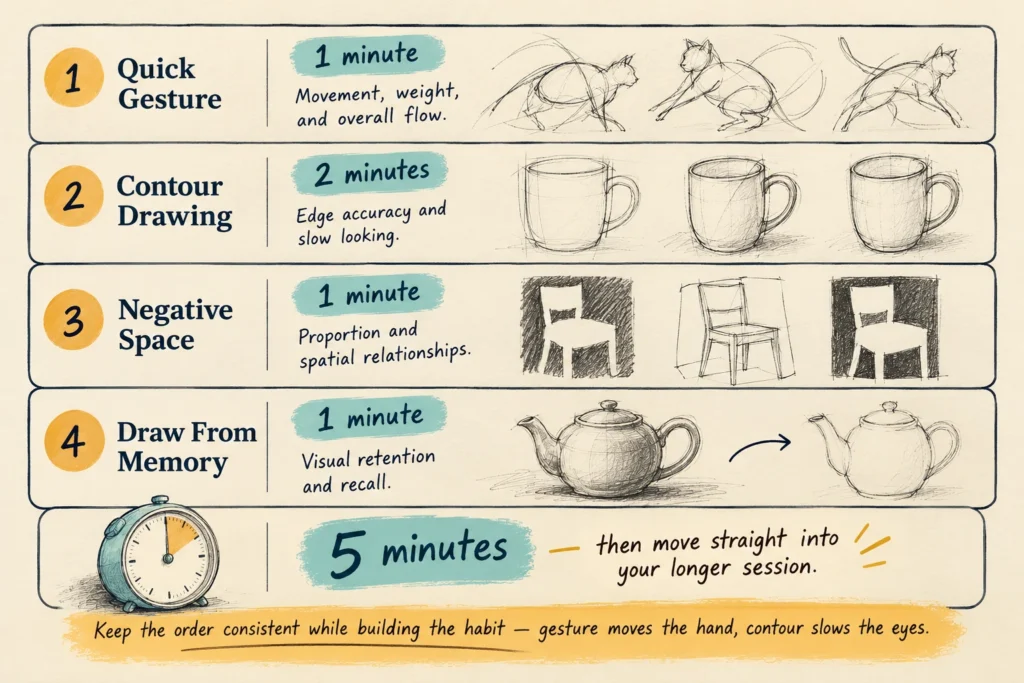
You have the exercises. Now you need a simple plan for using them. A fixed five-minute routine takes the guesswork out of your warm-up, so you can start looking and drawing instead of deciding what to practise.
Here’s a five-minute sequence you can use as your default. Swap in the other exercises when you want to focus on a different skill:
| Drill | Time | Skill it trains |
|---|---|---|
| Quick Gesture | 1 minute | Movement, weight, and overall flow |
| Contour Drawing | 2 minutes | Edge accuracy and slow looking |
| Negative Space | 1 minute | Proportion and spatial relationships |
| Draw From Memory | 1 minute | Visual retention and recall |
Keep the order consistent while you’re building the habit. Gesture gets your hand moving first, while contour and negative-space work slow your looking down. The final memory exercise gives you a quick check on what you actually noticed.
Once the five minutes are up, move straight into your longer drawing session. The warm-up doesn’t need to look finished. Its job is to get your eyes working before the longer work begins.
Keep Your Eyes Sharp and Your Sketches Honest
Honestly, five focused minutes of looking will do more for your drawing than an hour of hopeful erasing. Your eyes lead, and your hand follows whatever they find.
So pick one object on your desk tonight and give it the full five minutes before you start. Repeat the drill before every session, and accuracy builds week after week, until slow looking becomes second nature.
Want to keep building that habit? Join The Heart Project for art classes and observation drills that give you a regular space to practise.
Leave a Reply