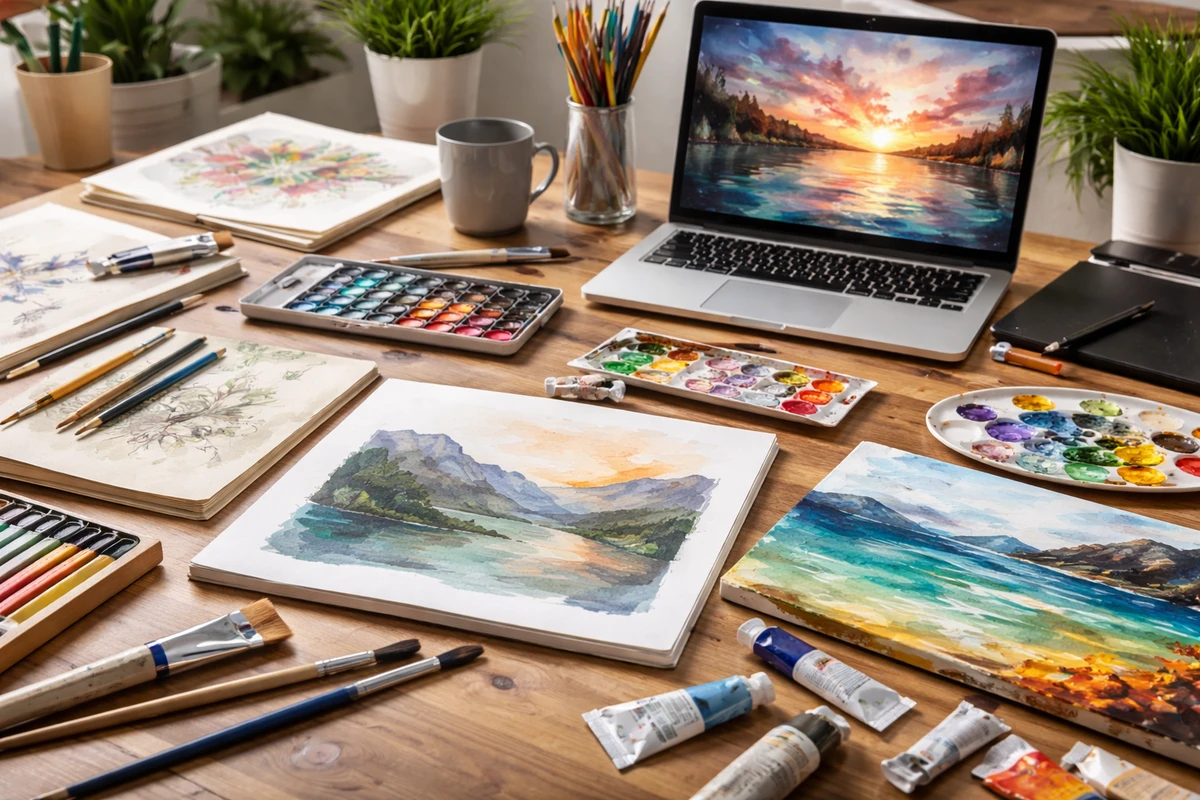
Research shows that 85% of teachers who combine creative approaches see their students develop stronger problem-solving skills. And the same principle applies when you explore different art mediums.
That’s why adults are picking up creative skills through online courses, especially as the barrier to entry is lower than ever. In fact, you can start painting with basic supplies from any art store, learn photography with the camera you already own, or download free 3D software tonight.
In this article, we’ll explain the advantages of exploring multiple creative mediums. You’ll also learn what beginners learn in painting classes online, photography courses, and 3D design programs.
Let’s find out which medium fits your schedule and creative interests.
Why Exploring Multiple Art Mediums Expands Your Skills
Trying different art mediums builds critical thinking skills that improve your work across all creative disciplines. When you switch between painting, photography, and digital tools, your brain starts connecting ideas in more creative ways, which wouldn’t happen if you stuck to just one medium.
To give you an idea, learning photography trains your eye for composition, which directly improves how you frame paintings. If you understand where to place your subject in a photo, that knowledge carries over to sketching on canvas.
Vice versa, photographers who study painting understand color theory better and create more dynamic edited images afterward. Once you know how warm and cool colors interact on canvas, you start noticing these relationships in your photos too.
Similarly, 3D design forces you to think in three dimensions, which makes drawing perspective way easier. You can rotate a digital object and view it from every angle, and improve your sense of traditional drawing.
In short, working in multiple mediums makes you notice shadows, reflections, and textures everywhere you go. And that coffee cup on your desk suddenly becomes interesting because you’re seeing it like an artist instead of just another everyday object.
Painting Classes Online: What Beginners Can Expect to Learn
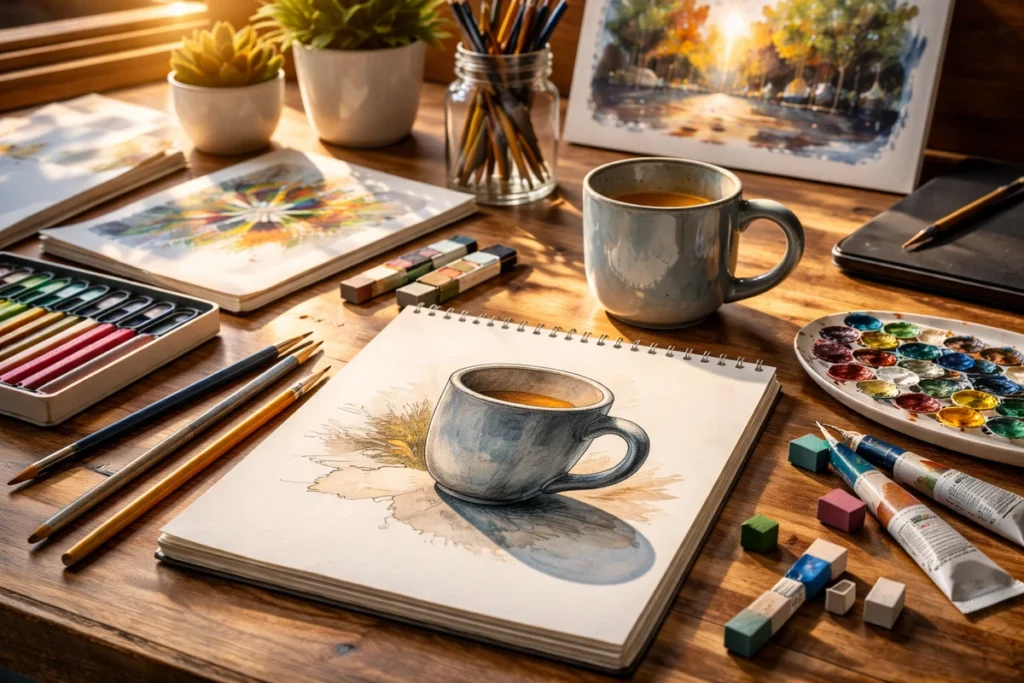
You can expect a noticeable difference between learning to paint in person and taking painting classes online. After guiding beginner painters through their first canvases, we’ve seen that online courses allow you to pause, rewind, and practice techniques at your own pace without feeling rushed.
This is how you set up your space properly for your painting practice.
Watercolor, Acrylic, or Oil: Picking Your Modern Art Medium
Watercolors dry fast and create transparent effects, but they’re harder to control for beginners. Because of this, you can’t really fix mistakes once the paint hits the paper.
On the other hand, acrylics are forgiving since you can paint over mistakes and they dry quickly for layering. That’s why most online courses for adults start with acrylic painting because it behaves predictably and doesn’t require special ventilation or expensive materials.
Meanwhile, oil paints stay wet longer, so you can blend and adjust your work over days. They take more patience and understanding of how different pigments interact, but professional artists love oils exactly for this reason.
Common Tools: Brushes, Canvas, and Workspace Prep
You don’t need expensive supplies to start creating art. Just student-grade paints and a few brush sizes work fine for learning basic techniques in any online course. Optionally, you can keep various materials like palette knives, sponges, and old credit cards to create interesting textures.
Also, you can start with canvas panels, which are cheaper than stretched canvas and easier to store when you’re testing things out. They give you the same painting surface without taking up half your closet.
Pro Tip: Protect your table with plastic sheeting and keep paper towels and water cups within arm’s reach (nobody’s immune to paint spills).
Color Mixing and Layering Techniques for Beginners
We recommend starting with primary colors and white to learn how mixing creates hundreds of color variations.
What’s more, layering thin coats builds depth and richness instead of applying thick paint all at once. While layering, let each layer dry completely before adding the next one, because rushed layers make vibrant blues and reds become brownish messes.
Photography Course for Beginners: Beyond the Auto Button
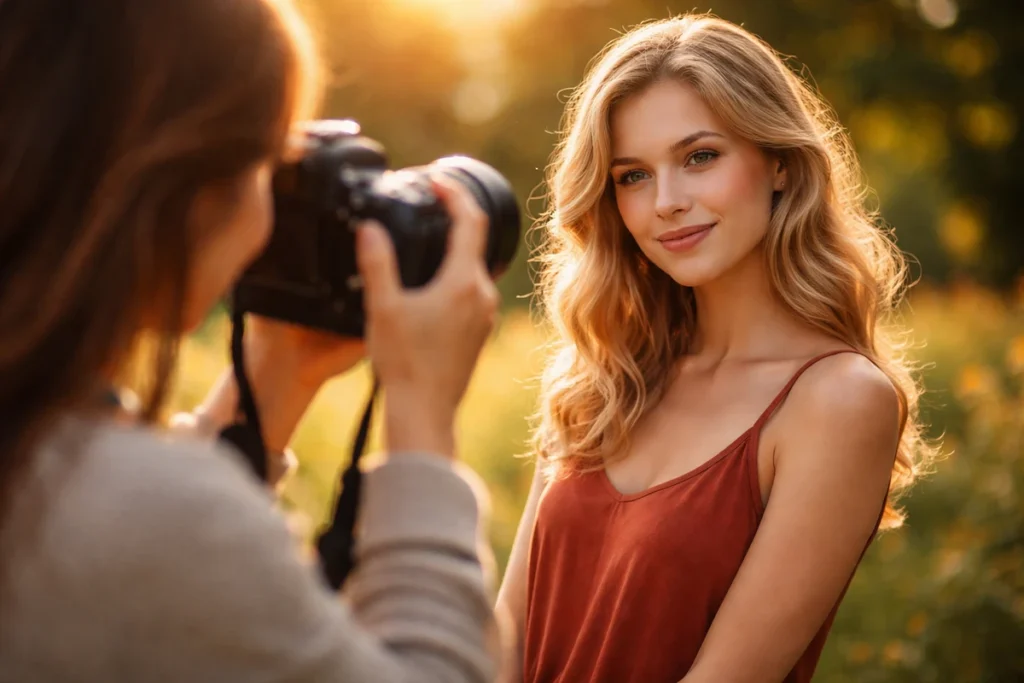
Shooting in manual mode allows you to control how your photos look right from the start instead of letting the camera guess. Unfortunately, most people freeze up at this part because the settings may seem complicated at first.
But once you understand these three basic controls, everything will click.
ISO, Aperture, and Shutter Speed in Plain English
ISO controls how sensitive your camera is to light. Basically, higher numbers let you shoot in darker spaces, but if you push it too far, your pictures will get grainy and look unprofessional.
Equally important is aperture. It is the opening in your lens that controls how much light enters and what stays in focus. Think of it like your eye’s pupil getting bigger in dim light and smaller in bright conditions. With this one setting, you can keep the background crisp or create the blurred effect you often see in portraits.
Beyond these, shutter speed determines how long light hits the sensor, which affects motion blur or frozen action shots. To give you an idea, fast shutter speeds freeze a skateboarder mid-air, while slow speeds turn waterfalls into smooth, silky scenes.
How to Balance the Settings for Perfect Photos
The secret is finding that sweet spot where you get enough light without sacrificing image quality (takes some practice to get the balance right).
A good rule of thumb is: use a wider aperture to let more light in without cranking ISO to extreme levels. This works especially great for indoor shots or evening photography when natural light starts fading.
Along with that, slow your shutter speed if your subject isn’t moving and rest your camera on a table or wall. Because even small movements blur photos at slow speeds.
Creating Blur and Focus with Depth of Field
A wide aperture like f/1.8 creates blurry backgrounds that put focus on your subject in portraits. We’ve watched countless students have that moment when they finally nail this technique, and their photos suddenly look professional.
On the contrary, narrow apertures like f/11 keep both foreground and background sharp in landscape shots. Photographers use this when they want that mountain range as well as the wildflowers in front to be perfectly clear.
3D Design Basics: Creating Digital Objects from Your Ideas
3D design is the fastest way to visualize your ideas from every angle before committing to a physical build. Unlike painting or photography, where you work with flat surfaces, this medium lets you create objects, characters, and environments that exist purely in digital space first.
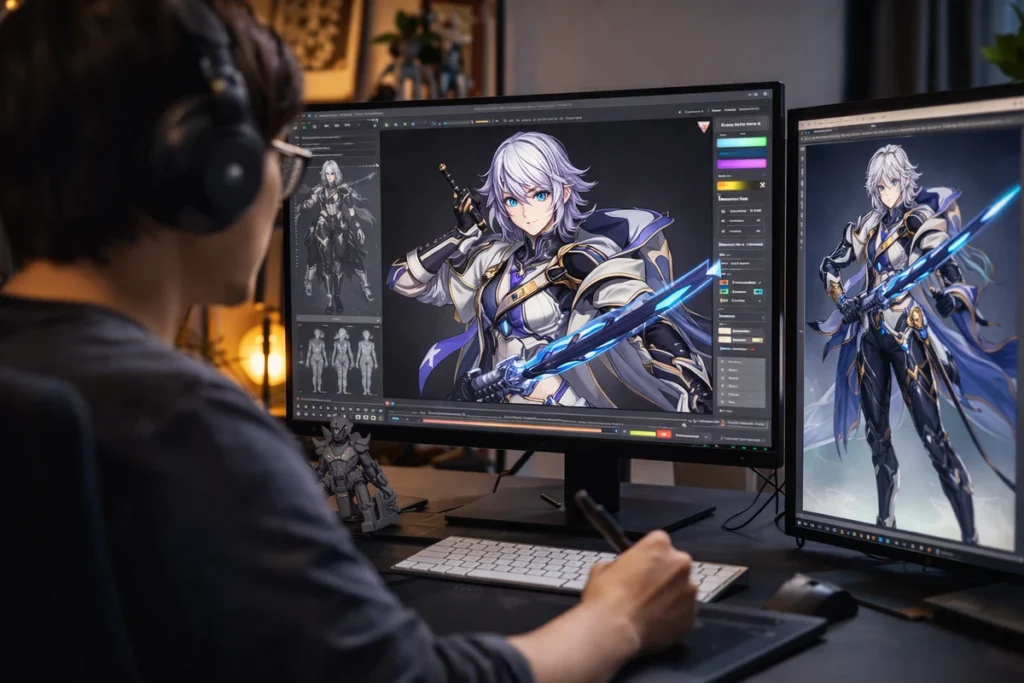
Take a look at how 3D design opens creative doors.
Getting Started with Free 3D Software and Online Courses
Beginner-friendly software like Blender is free and has massive online tutorial libraries for self-paced learning. You’ll learn to manipulate shapes, add textures, and control lighting to make digital objects look realistic.
Think of it like digital sculpture, where you’re building forms on your computer instead of working with clay. 3D work also lets you rotate and view your creation from every possible angle that traditional art mediums can’t.
What You Can Create with 3D Design
3D design media generally powers game design, product mockups, animation, and architectural rendering today. Artists use it for projects like designing furniture and creating characters for video games.
In fact, the range of specific applications keeps growing as the technology gets more accessible. For example, you can prototype a coffee mug, design a fantasy character, or plan out an entire room renovation before buying a single piece of furniture.
Pick One and Start Creating Today
Online courses for painting, photography, and 3D design let you learn at your own pace without the pressure of keeping up with a classroom. You can pause when life gets busy and pick back up whenever you have free time. Especially when most platforms give you access to lessons for months.
If you’re ready to find your creative passion, The Heart Project offers beginner-friendly art courses taught by working artists who remember what starting out feels like. The community knows the joy of creating something with their own hands and wants to help you experience that same feeling. So visit us to see which medium calls to you first.
Leave a Reply